

Do you need a passport to go to Mexico? If you’re flying, yes: every US citizen needs a valid passport book. By land or sea, a passport card, a Trusted Traveler card such as SENTRI, or an Enhanced Driver’s License is enough, though a passport book is still the safest choice. The fees and document rules below reflect 2026 figures published by the US Department of State and Mexico’s immigration authority at the time of writing. Government fees are adjusted periodically, so it is worth confirming current numbers before applying for any document.
The Quick Answer for 2026 Travelers
- By Air: YES. A valid passport book is required, with no exceptions, regardless of trip length or how close the destination is to the border.
- By Land or Sea: YES, but with more flexibility. A passport card, a Trusted Traveler card (SENTRI, NEXUS or Global Entry), or in some cruise scenarios a birth certificate can substitute for the full passport book.
- Do Americans need a visa? NO. US tourists do not need a visa for stays of up to 180 days, although the immigration officer decides how many days you are actually granted.
- The Golden Rule: whatever the mode of travel, packing a passport book is still the safest choice. It is the only document that guarantees a fast way home if a medical emergency or family situation forces an unplanned flight back to the US.
Documents Needed to Travel to Mexico by Air, Land and Sea
The accepted documents shift depending on how a traveler enters the country, and mixing up the rules between methods is where most people run into trouble.
| Method | Accepted Documents | Not Accepted | Risk Level |
|---|---|---|---|
| By Air | Passport Book, valid through the length of the stay | Passport Card, state ID, driver’s license, including REAL ID | High (denied boarding) |
| By Land or Car | Passport Book, Passport Card, Trusted Traveler cards (SENTRI, NEXUS, Global Entry), Enhanced Driver’s License (EDL) | Standard driver’s license, birth certificate alone for adults | Low |
| By Sea (Cruise) | Passport Book, Passport Card, Trusted Traveler cards; closed-loop cruises may accept a birth certificate plus photo ID | Standard ID alone on non closed-loop itineraries | Medium |
Flying leaves no room for substitutes: a passport book is the only document Mexican immigration and every airline will accept, and a REAL ID’s gold star does not change that, no matter how official it looks. The longer list for land and sea comes from the Western Hemisphere Travel Initiative (WHTI), the US rule that sets which documents you need to re-enter the United States by land or sea. Mexico’s entry check is separate, which is one more reason a passport book or card is the safest thing to carry.
Do Americans Need a Visa to Go to Mexico in 2026?
The reassuring part of this question is also the part that creates confusion: American tourists don’t need a visa to enter Mexico for tourism, business, or transit, provided the stay doesn’t exceed 180 days. That 180 days is a maximum, not a guarantee: the immigration officer at your point of entry decides how many days to grant, so have your return ticket and accommodation details ready to show. What every visitor does need, regardless of nationality, is the FMM (Forma Migratoria Múltiple), an entry permit rather than a visa, sometimes still called a tourist card.
Travelers arriving by air at major airports such as Cancún or Mexico City increasingly receive this electronically, either as a digital stamp in the passport or a code tied to the immigration record, since paper FMM forms have been phased out at several large airports. Travelers crossing by land still need to stop at the immigration office (INM) at the border, complete the FMM online or on paper, and pay the associated fee, which for 2026 runs close to $50 to $58 (983 pesos), though the fee is waived for land crossings of seven days or fewer. Travelers arriving by air rarely notice this charge at all, since it is bundled into the airline ticket as part of the taxes and fees line. Cruise passengers pay a separate, smaller fee instead: $5 per person since 2025, rising to $10 from August 1, 2026, collected in advance by the cruise line as part of port charges.
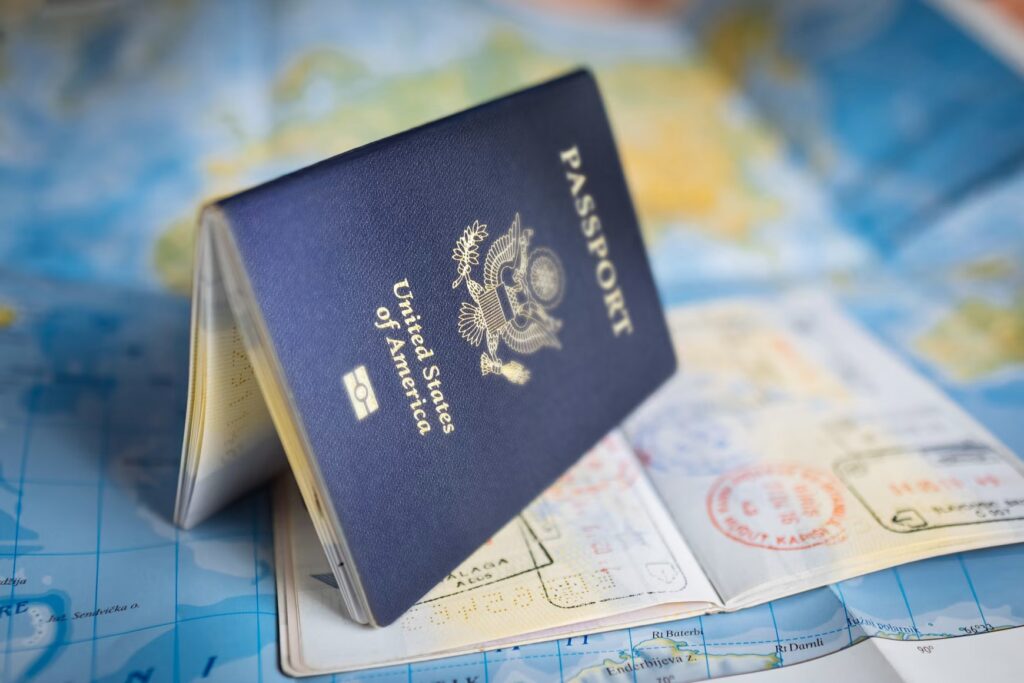
Do You Need a Passport to Go to Mexico by Car? (Land Border Rules)
Driving or walking across a land border, common for travelers near Tijuana, Baja California, or the Texas crossings, comes with a wider choice of documents than flying, because the WHTI rules for returning to the US by land are noticeably more forgiving. There are a few practical options:
- Passport Card: the government application fee is $30, compared with $130 for a passport book, though first-time applicants also pay a $35 execution fee at the acceptance facility, bringing the realistic total to about $65 for a card versus $165 for a book. The card only works for land and sea travel; it can’t be used to board a flight.
- SENTRI Card: built around expedited border lanes, this option suits travelers who cross the US-Mexico border frequently rather than just once or twice a year. NEXUS and Global Entry cards are also accepted at land crossings.
- Enhanced Driver’s License (EDL): issued by only a small number of US states, an EDL functions similarly to a passport card at land crossings. It’s worth repeating because it trips up so many travelers: an EDL isn’t the same document as a REAL ID, and a REAL ID, gold star included, has no standing as an international travel document anywhere outside the United States.
Driving Your Own Car into Mexico
If you’re taking your car, the right ID is only half the paperwork. US auto insurance is generally not valid in Mexico, so buy a Mexican auto liability policy before you cross; most insurers sell short-term coverage online by the day. If you plan to drive beyond the border zone and the tourist free zones, such as Baja California and parts of Sonora, you also need a Temporary Vehicle Import Permit (TIP), which you can get online in advance through Banjercito or at the border. The TIP requires a refundable deposit, and it must be cancelled when you leave Mexico to get that deposit back.
Special Scenarios: Minors, Cruises, and Green Card Holders
Traveling with minors under 16
Children crossing by land or on a closed-loop cruise can sometimes travel on a certified copy of a birth certificate rather than a full passport, mirroring the flexibility adults get under WHTI. That flexibility disappears the moment a flight is involved: children of any age, including infants, need their own passport book to fly into or out of Mexico. A child traveling with only one parent also benefits from carrying a notarized letter of consent from the other parent, a precaution Mexican immigration officials and US Customs and Border Protection both recommend to guard against parental child abduction, even when it is not uniformly demanded at every checkpoint.
Green Card holders and other non-citizens
A lawful permanent resident doesn’t need a Mexican visa to enter as a tourist, mirroring the rule for US citizens. What changes is the supporting paperwork: a green card alone isn’t sufficient, since it confirms US residency rather than citizenship of any particular country. Green card holders need to carry their passport from their country of citizenship alongside the green card itself, since the passport is what Mexican immigration uses to record entry and exit.
Smart Traveler Checklist Before You Cross

A few details get exaggerated online to the point of becoming myths, so it is worth separating fact from rumor before crossing.
- Passport validity: Mexico does not enforce a six-month passport validity rule the way many other countries do. Immigration only requires the passport to remain valid through the entire length of the stay, though airlines or any country on a connecting itinerary may apply stricter rules of their own, so it is worth checking connections separately.
- Blank pages: at least one blank page is expected for an entry stamp. A passport that is full of stamps can cause delays even when it is technically still valid.
- Travel insurance: not legally required to enter Mexico, but it covers a real gap, since most US health insurance, Medicare included, is not accepted by Mexican hospitals, which typically expect payment up front. Prices vary with age, trip length, and coverage limits, so compare medical-only plans with policies that also cover trip interruption and evacuation.
- Renewing instead of applying: if you already have an eligible adult passport, renewing by mail or online costs $130 for a book or $30 for a card, with no $35 execution fee.
- Processing time: routine passport processing times shift with demand, so check the current estimate on the State Department’s processing times page and start the paperwork well before the rest of the trip planning.
Common Passport Questions for Mexico Travel
Can I travel to Mexico with an expired US passport?
No. Mexican immigration and every airline serving the route will deny boarding or entry for a passport that has expired, even by a single day. A traveler whose passport expires while already in Mexico needs to contact the nearest US embassy or consulate to apply for a new passport before flying home; in true emergencies, a limited-validity emergency passport can usually be issued within a day or two.
Does a REAL ID work for traveling to Mexico?
No, and this is the single most common misunderstanding among US travelers. A REAL ID-compliant driver’s license, identifiable by the gold star in the corner, is valid for domestic flights within the United States and for entry into federal buildings. It has no validity as an international travel document, which means it cannot substitute for a passport at the Mexican border, whether arriving by air, land, or sea.
What happens if I lose my passport while in Mexico?
Losing a passport in Mexico rules out flying home until a replacement is issued. The practical steps are to file a report with local police to get a record of the loss, photograph any remaining identification, and schedule an appointment as soon as possible with the US Embassy in Mexico City or the nearest US consulate or consular agency, with offices in several cities including tourist areas such as Cancún. A replacement passport generally costs the same as any other adult passport application, which works out to around $165 once the application and execution fees are combined, and consular staff can often issue a limited-validity emergency passport quickly enough to keep a return flight on schedule.
Do I need a passport to go to Mexico on a cruise?
The answer depends on the itinerary. A closed-loop cruise, one that departs from a US port such as Miami or Galveston and returns to that same port after stopping in Mexico, allows US law to treat a birth certificate plus a government-issued photo ID as sufficient under WHTI. A cruise that starts in the US but ends somewhere else entirely requires a full passport book, no substitutions. Even on a closed-loop cruise, carrying a passport book is the more cautious choice: a missed ship departure or a medical situation requiring an emergency flight home from a Mexican port leaves a traveler without a passport stuck at the border with very few options.
Final Verdict: Yes, Bring a Passport

>> Bangkok to Chiang Mai: Flight, Sleeper Train or Bus Compared
So, do you need a passport to go to Mexico? The honest answer is yes, in some form, for almost every scenario a traveler is likely to encounter. Land and sea travelers have the flexibility to use a passport card instead of the full book, but a passport book remains the version that works everywhere, covers every mode of transportation, and removes any uncertainty if plans change mid-trip. Given that routine processing can take several weeks, starting the paperwork early leaves enough room to handle delays without rushing into expedited fees. Whatever document ends up in hand, having it sorted ahead of time means one less thing standing between a traveler and the rest of the trip.